

Do Data Centers Lower Home Values?
By Joe Nelson, Retired Air Force, Nelson Home Group Team Leader and Mortgage Loan Originator
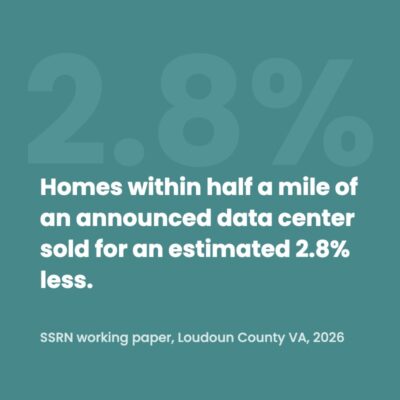
The evidence is mixed, and anyone who gives you a one-line answer is skipping the homework. The clearest localized finding: a 2026 working paper found homes within half a mile of an announced data center in Loudoun County, Virginia sold for an estimated 2.8% less than comparable homes farther out. The clearest opposing finding: a 2025 George Mason University analysis of the same region found no statistical evidence that proximity to a data center lowers home values at all. What the research does agree on is that any measured effect lives close to the site, not across a metro. With Google building a confirmed campus in Kansas City’s Northland, a project Port KC has authorized up to $10 billion in taxable revenue bonds to finance, here’s how I’d actually use that.
My full read on the Kansas City version of this question is in the video.
Own a home in the Northland, or thinking about buying one? If you want a straight answer on what the data center boom means for your situation, call me at (816) 680-6624 (KW KC North Office: (816) 452-4200) or email [email protected].
What does the research say about data centers and property values?
The George Mason model controlled for 14 variables, from lot size to the distance to Dulles airport.
Start with the two most useful studies, both from the most saturated data center market in America. A working paper by Michael Rubinovitz of George Washington University, posted to SSRN in January 2026 and revised in May 2026, studied transactions in Loudoun County, Virginia and found that homes within half a mile of an already announced data center sold for an estimated 2.8% less than comparable homes slightly farther away (SSRN). On a $400,000 house, 2.8% is about $11,200. On the other side, an August 2025 George Mason University analysis of Northern Virginia ran a hedonic regression on 2023 home sales, controlling for 14 variables, and failed to find statistical evidence that data center proximity hurts values; in their model, homes closer to data centers actually carried higher values, holding everything else constant (GMU).
Those two findings are not as contradictory as they look. Different years, different methods, different distance bands. And note the two schools: the 2.8% paper is a single author working paper out of George Washington University, and the no-effect analysis is from George Mason University. New working papers keep appearing on both sides of this question, so treat every number, including the 2.8%, as one study’s estimate rather than a universal rule. I treat it as a useful data point in a mixed and fast-moving research record, not as a Kansas City appraisal rule. I covered the bigger picture in my post on what Google’s data center means for Kansas City homeowners.
Last verified: August 27, 2026.
| Evidence | Geography and method | Finding | Limitation |
|---|---|---|---|
| SSRN working paper (posted Jan. 2026, revised May 2026) | Loudoun County, VA home transactions | Homes within 0.5 miles of an announced data center sold for an estimated 2.8% less | Working paper, one market, not yet peer reviewed |
| George Mason University analysis (Aug. 2025) | Northern Virginia, 2023 sales, hedonic regression with 14 controls | No statistical evidence that proximity lowers values | One sales year, before the newest buildout wave |
| Class action covered by local TV, Dowagiac, Michigan (2026) | One operating facility used for digital asset mining | Residents allege constant mechanical noise in an ongoing dispute | Allegations in litigation, not a price study |
| Where the record agrees | Across studies | Any measured effect concentrates near the site rather than metro-wide | No published study measures the Kansas City sites yet |
Sources: SSRN working paper · George Mason University
Why would a data center lower nearby home values?
Google’s confirmed campus sits near I-435 and US-169 in Clay County, while the proposed Kestrel site is in Platte County.
Three reasons show up in reporting again and again. Noise: some operating facilities generate persistent mechanical noise from cooling equipment, and residents of Dowagiac, Michigan filed a class action in 2026 alleging that a data center there used for digital asset mining emits unreasonable, excessive noise from its cooling fans (WWMT). Construction: a hyperscale campus means years of trucks and cranes, not months; the OSHA partnership agreement for Google’s Kansas City campus says the build “will likely reach six years of construction.” And perception: some buyers simply don’t want an industrial neighbor, the same way some buyers pass on homes backing to a highway or a rail line. None of those forces has been shown to reach across a metro. All of them are strongest at the fence line.
Can a data center raise home values?
Yes, indirectly, though the research does not show a universal price gain for nearby homes. The support case: billions in investment, upgraded infrastructure, and years of well-paid construction demand flowing into the local economy. Meta’s Northland build used about 1,500 construction workers (KCUR), and preliminary BLS data show Kansas City construction employment up 3.3% year over year as of July 2026 while overall nonfarm employment grew 0.7%. When a company like Google commits to the same metro twice, other employers and investors notice. One honesty note: tax-base gains build slowly here, because these projects come with large abatements, including a 25-year, 75% property tax exemption on Google’s confirmed campus per Port KC.
What does this mean for Kansas City’s Northland?
Ordinance 251031 passed in January 2026 and requires will-serve letters from every data center project.
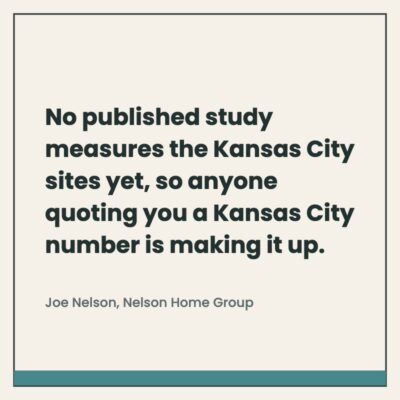
No published study measures the Kansas City sites yet, so anyone quoting you a Kansas City number is making it up. My read is that any effect is more likely to be local than metro-wide, consistent with the Virginia research, but that is a scenario, not a Kansas City statistic. There are two sites to watch: the confirmed Google campus near I-435 and US-169, which I mapped in my post on where Google is building its data center in Kansas City, and the proposed Project Kestrel campus in Platte County. Kansas City also has a protection Northern Virginia largely built after the fact: the January 2026 zoning rewrite bars data centers outright from residential districts and most office and business districts; where they are still allowed in the business and downtown districts, they now need a special use permit, and large-format projects face noise, setback, and screening rules. The electric bill side of this boom gets its own post on whether data centers will raise your electric bill. The right response is not fear. It’s a parcel map and ten minutes of homework.
How do I protect myself as a buyer or seller?
Buyers: before you write an offer near either site, have your agent pull the zoning on the surrounding parcels and measure the distance from the house to the nearest data center boundary, parcel to parcel. Distance and zoning are the two variables the research points to most consistently, alongside site design and what was already built around you. Sellers near a site: price honestly, disclose honestly, and market the corridor’s growth instead of hiding from it. In my Northland work across Kansas City, Liberty, Gladstone, and Smithville, homes sell next to highways, power lines, and rail yards all the time. The losing strategy is pretending the neighbor isn’t there. The winning strategy is pricing it right and telling the story straight. For the broader picture of where prices sit, start with my Kansas City market update, then search current Northland listings with the site’s map tools.
Frequently Asked Questions
How much do data centers lower property values?
The research is mixed. A 2026 working paper on Loudoun County, Virginia found homes within half a mile of an announced data center sold for an estimated 2.8% less, while a 2025 George Mason University analysis of Northern Virginia found no statistical evidence that proximity lowers values. Where effects appear, they concentrate close to the site and fade with distance.
Do data centers make noise?
Some operating facilities generate persistent mechanical noise from cooling equipment, and residents of Dowagiac, Michigan allege constant noise from a digital asset mining data center in an ongoing lawsuit. Kansas City’s January 2026 zoning rules added noise, setback, and screening requirements for large-format data center projects in the districts where they are allowed.
Will the Google data center lower home values in Kansas City?
No published study measures the Kansas City sites yet, and I won’t pretend otherwise. Based on the Virginia research, any effect is more likely to concentrate on homes within sight and sound of the site near I-435 and US-169 than to move the metro. If you own near the site, the smart move is a street-level pricing conversation, not a panic decision off a headline.
Should I sell my house before the data center is built?
Selling in a panic because of a headline is how homeowners leave money on the table. The research shows mixed results that concentrate very close to sites, Kansas City’s new zoning adds buffers, and construction demand is active in the Northland economy right now. Get a real valuation for your specific street before making any decision.
Is the 2.8% home-value figure a Kansas City estimate?
No. It comes from one 2026 working paper on Loudoun County, Virginia, and a separate George Mason University analysis of the same region found no statistical evidence of a negative effect. It is useful evidence, but it is not a Kansas City appraisal rule and should not be applied to a Northland house without street-level comparable sales.
Ready to Talk?
If you own a home near either site, or you’re deciding whether to buy in the Northland while this boom plays out, that’s a fifteen-minute conversation with somebody who watches this market daily. No pressure, no script, just a straight answer about your street.
Call: (816) 680-6624
KW KC North Office: (816) 452-4200
Email: [email protected]
Web: https://nelsonhomegroupkc.com/