

Will Data Centers Raise Electric Bills in Kansas City?
By Joe Nelson, Retired Air Force, Nelson Home Group Team Leader and Mortgage Loan Originator
By design, no. Missouri and Kansas both approved rules in November 2025 built to stop data centers from shifting costs onto household bills, and Google says it pays for 100 percent of the power it uses plus the infrastructure costs its operations drive. What no rule can do is guarantee your total bill never rises for other reasons. My honest answer: the protections are real, they arrived before most of the announced projects begin service, and the right posture is watchful, not panicked. Here is what is actually in place, in plain English.
I cover the bills question, and everything else about the boom, in the full video.
Own a home in the Northland, or thinking about buying one? If you want a straight answer on what the data center boom means for your situation, call me at (816) 680-6624. My broker is Keller Williams KC North, (816) 452-4200. You can also email [email protected].
What are Missouri’s new rules for data center electricity?
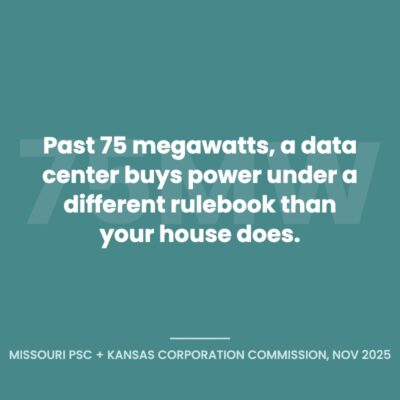
Below that line, a large user buys power on the same commercial schedules as any other business.
In November 2025, Missouri regulators approved a new rate structure for Evergy’s large-load customers, meaning hyperscale users like data center campuses pulling 75 megawatts or more (Missouri Public Service Commission). The design goal is simple: the companies creating the demand pay the costs that come with it, instead of spreading those costs across household bills.
Evergy’s approved Schedule LLPS spells out the terms. A qualifying customer signs for a minimum of 12 years, with an optional load ramp period of up to five years on the front end, so 17 years in total. It posts collateral equal to two years of minimum monthly bills. It pays a minimum monthly bill calculated on 80 percent of its contract capacity whether it uses that power or not. And it is responsible for the transmission deliverability costs its own load creates, as determined by the Southwest Power Pool.
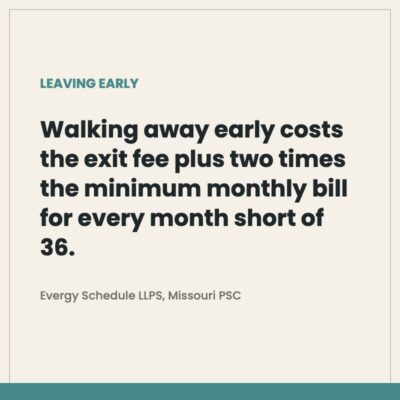
Getting out is expensive on purpose. The tariff requires 36 months of written notice to terminate or change rate schedules. The exit fee is the minimum monthly bill times the number of months remaining in the term, or 12 months’ worth, whichever is greater. Give less than 36 months’ notice and an early termination fee stacks on top of that: two times the minimum monthly bill for every month you came up short.
Rates for these customers also run higher than standard. KSHB reported that hyperscale data centers and other large users will pay up to 20 percent more for energy rates than regular customers, and Evergy Chief Customer Officer Chuck Caisley said the company uses all that revenue to help keep prices and rates lower for existing customers.
Do the same rules apply on the Kansas side of the metro?
Yes, and Kansas actually got there first. On November 6, 2025, a week before Missouri acted, the Kansas Corporation Commission approved a unanimous settlement creating a Large Load Power Service plan covering any new facility that begins service with a peak load forecast of 75 megawatts or more (Kansas Corporation Commission).
The terms rhyme with Missouri’s: a 12-year minimum plus an optional load ramp of up to five years for 17 years total, a minimum monthly bill based on 80 percent of contract demand, collateral equal to two years of minimum monthly bills, and an exit fee requiring a departing customer to pay all the minimum bills it would have been billed had it stayed on service.
Two lines in the KCC’s own announcement are the ones worth reading twice. First, demand and energy rates in the plan are designed to cover Evergy’s incremental cost to serve large load customers, so existing customers are not subsidizing those users. Second, any system upgrades necessary solely to serve the new or expanded customers get directly assigned to that customer. That is the cost-shifting question answered in the order itself, not in a press release.
| Term | Missouri (Schedule LLPS) | Kansas (Large Load Power Service) |
|---|---|---|
| Who it covers | New facility at 75 MW or more of monthly maximum demand | New facility beginning service at 75 MW or more of peak load |
| Minimum contract | 12 years | 12 years |
| Optional ramp | Up to 5 years, 17 years total | Up to 5 years, 17 years total |
| Minimum monthly bill | Based on 80 percent of contract capacity | Based on 80 percent of contract demand |
| Collateral | Two years of minimum monthly bills | Two years of minimum monthly bills |
| Exit fee | Minimum monthly bill times months remaining, or 12 months, whichever is greater | All minimum bills that would have been billed had service continued |
| Notice to terminate | 36 months in writing | Not specified in the KCC order |
| Upgrade costs | Customer pays transmission deliverability costs as determined by SPP | Upgrades needed solely to serve the customer are directly assigned to it |
What has Google promised about energy costs?
Google’s clearest public statement came on May 20, 2026, when it announced a $15 billion Missouri infrastructure investment, including a new data center in New Florence, in Montgomery County (Google, May 20, 2026). That New Florence campus is on the other side of the state, not in Kansas City, and I want to be precise about that because the headline number gets quoted locally as though it were ours. What travels is the policy language in the same announcement.
Google said that when it builds data centers, it pays for 100 percent of the power it uses and will cover the infrastructure costs directly driven by its operations. It said it has contracted to bring more than one gigawatt of new generation capacity to Missouri. And it announced a $20 million Energy Impact Fund to support programs that drive down monthly energy bills for households in Missouri, focused on Montgomery, Clay, Platte and other counties surrounding its planned data centers in Kansas City and New Florence. Clay and Platte are the two Northland counties where the Kansas City projects sit, so that fund is pointed at this metro on purpose.
Those are Google’s own commitments, not independent findings. They are on paper, dated, and checkable, which is more than can be said for most of what gets repeated about this subject.
Why are people still worried about their electric bills?

Kansas approved its version of these rules a week before Missouri approved its own.
Because nationally, this question is genuinely contested, and the research does not reduce to a slogan. Some analyses find data centers have not driven most recent household increases. Utilities point to grid maintenance and reliability work behind recent rate cases. Consumer advocates in several states have documented cost-shifting concerns where large-load tariffs were written loosely, which is exactly why the terms in Missouri’s and Kansas’s orders matter more than the fact that an order exists.
Bills also rise for reasons that have nothing to do with servers. Fuel costs, storm restoration, transmission investment and ordinary rate cases all move the number on your statement. Untangling those causes is what rate cases are for, and they happen on the record.
My take as the guy who watches housing costs for a living: both states’ rate designs are built to shield you, nobody can promise you a flat bill in a region adding this much load, and anyone who hands you a guaranteed number in either direction is selling something.
Will the data centers strain Kansas City’s water supply?
I do not know yet, and neither does anyone quoting a scary number. Data center campuses can use significant water for cooling, and Google has not published site-level water figures for its new Kansas City campus.
What exists on the protection side is the January 2026 zoning rewrite. The City Council unanimously approved Ordinance 251031 on January 15, 2026, and it added a requirement that water, energy and other public utility providers submit a letter saying they have the capacity to meet a proposed data center’s demand (KCUR). That is the will-serve letter, and it is a real gate that sits in front of approval rather than behind it. Local reporters have been pressing on the water question all year, and they should keep pressing.
What should Kansas City homeowners actually watch?
Kansas words it differently: a departing customer owes every minimum bill it would have been billed had it stayed.
Three things. First, the rate cases. Rate design gets decided in front of the Missouri Public Service Commission and the Kansas Corporation Commission, on the record, in filings anyone can read. If a large-load tariff gets loosened, it happens there and it happens in public.
Second, Evergy’s statements about how large-load revenue is applied, since the company says that money helps hold down prices for existing customers. That is a claim you can hold them to in the next rate case.
Third, the next project approval. Under the new zoning rules, utility capacity confirmations now happen in public before a data center is approved, which is where any real capacity problem would surface first.
This is the last post in my five-part Northland data center series. If you are catching up, start with the pillar on what Google’s data center means for Kansas City homeowners, then read where Google is building its Kansas City campus, what Project Kestrel actually is, and whether data centers lower home values. If you want the neighborhood-level view, I keep community pages for Smithville, Liberty, Gladstone and Kansas City, plus the latest Kansas City market update and a live home search. And if the boom raises a question about your own house, your street or your bills, I would rather you call me than lose sleep over a headline.
Frequently Asked Questions
Who pays for the grid upgrades data centers need?
The data centers. In Kansas, the Corporation Commission’s approved plan states that any system upgrades necessary solely to serve a new or expanded large-load customer are directly assigned to that customer. In Missouri, Evergy’s Schedule LLPS makes the customer responsible for the transmission deliverability costs its own load creates, as determined by the Southwest Power Pool. Large-load customers in both states also post collateral equal to two years of minimum monthly bills before service begins.
How long are data center power contracts with Evergy?
At least 12 years, extendable to 17 years with an optional load ramp period of up to five years, in both Missouri and Kansas. Missouri’s tariff also requires 36 months of written notice to terminate, and an exit fee applies even when a customer gives the full notice.
Do data centers pay higher electric rates than regular customers?
Yes. KSHB reported that under the plan Missouri regulators approved, hyperscale data centers and other large users will pay up to 20 percent more for energy rates than regular customers, and Evergy Chief Customer Officer Chuck Caisley said the company uses all that revenue to help keep prices and rates lower for existing customers. They also carry costs regular customers never see, including directly assigned upgrade costs and two years of collateral.
Has my Evergy bill already gone up because of data centers?
That attribution is disputed. Household bills rise for several reasons, including fuel costs, storm restoration and grid maintenance and reliability work, and whether data centers share the blame is exactly what rate cases in front of state regulators sort out. The large-load rules in both states were written to keep data center costs separate from household bills going forward.
Does giving notice eliminate Evergy’s exit fee in Missouri?
No. Evergy’s Missouri Schedule LLPS requires 36 months of written notice to terminate, and the exit fee still applies. It is the minimum monthly bill times the number of months remaining in the term, or 12 months’ worth, whichever is greater. Giving less than 36 months’ notice adds an early termination fee on top: two times the minimum monthly bill for every month short of the 36.
Ready to Talk?
If you own a home near either site, or you are deciding whether to buy in the Northland while this boom plays out, that is a fifteen-minute conversation with somebody who watches this market daily. No pressure, no script, just a straight answer about your street.
Call: (816) 680-6624
KW KC North Office: (816) 452-4200
Email: [email protected]
Web: https://nelsonhomegroupkc.com/