

Does Population Growth Raise Home Prices?
By Joe Nelson, Retired Air Force, Nelson Home Group Team Leader and Mortgage Loan Originator
Does population growth raise home prices? Not on its own. Growth tells you where people are moving. Price is set by supply, financing costs, and what competing homes are available the week you sell. In fast-growing suburbs the new supply is new construction, and a builder can offer a buyer things you cannot offer out of your own equity.
This is the Thursday companion to my pillar on the fastest-growing Kansas City suburbs. Earlier this week I covered Overland Park population growth and why it missed the top five and what buying a house in Spring Hill, Kansas looks like right now.
Moving to Kansas City or thinking about it? Grab my free KC Relocation Guide. It covers the metro side by side, what to expect on both sides of the state line, and how to narrow a list of suburbs down to two.
Does Population Growth Raise Home Prices Automatically?
Freddie Mac’s economists published this model in January 2021, using national data rather than Kansas City figures.
It does not, and that assumption is baked into most growth listicles. The reasoning sounds airtight: more people want to live here, demand goes up, prices go up. The step that gets skipped is supply. Growth at that scale generally requires new housing capacity, so the demand and the supply tend to arrive together. Population estimates by themselves do not tell you when those units were permitted, finished, or occupied.
Growth is a demand signal and a supply signal at the same time. Which of the two is winning in a given month is a local question with a local answer, and it changes.
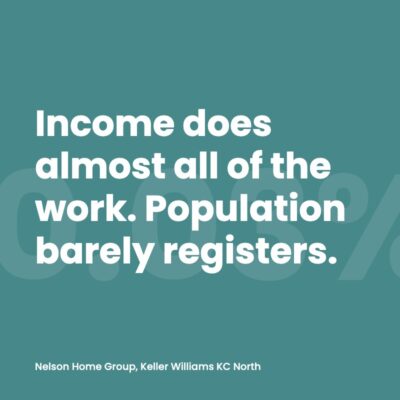
There is research that puts a number on it. Freddie Mac’s economists modeled this in 2021 and found that a 1% increase in population raises house prices by roughly 0.03%, while a 1% increase in per capita income raises them by roughly 1.5%. In their words, population accounts for only 0.5% of the change in house prices. Income does almost all of the work. Population barely registers.
That is a 2021 study and the coefficients are national rather than Kansas City specific, so take it as direction rather than a local forecast. But the direction is the whole point. When someone tells you a suburb is a good buy because it is growing fast, they are leaning on the weakest variable in the model.
There is a version of the question that does have a yes attached to it. The price effect is strongest where housing supply cannot respond, usually because of geography, zoning, or both. Before you assume that applies here, test it against current inventory and how fast new homes are actually delivering, rather than assuming it from a map.
What Does New Construction Do to Your Resale Value?
This is the mechanical part, and it is where the money actually moves. When you sell a house that is four or five years old in a growth suburb, your competition includes the builder a few streets over with unsold inventory and a sales budget. And I want to correct something you will read on a lot of real estate blogs: it is not true that a seller cannot buy down a buyer’s rate. You can. Fannie Mae names the property seller as a permitted source of buydown funds, and VA names the seller first. What limits you is a cap, not a prohibition.
| When you sell | Builder three streets over can offer | What you can offer |
|---|---|---|
| Interest rate | A permanent or temporary buydown, often through an affiliated lender, budgeted across the whole subdivision | A seller-funded buydown too. Capped by Fannie Mae interested-party limits of 3, 6 or 9 percent by LTV, or 4 percent of reasonable value on a VA loan |
| Closing costs | A credit, often tied to using the builder’s lender | A seller credit, paid out of your equity |
| Condition | Newer, usually with a limited builder warranty. Verify the scope, the exclusions and the term | A home that is several years old, with a condition and maintenance history you can inspect |
| Timing | A finished spec home or a build slot | Whenever you can be out |
| Presentation | A professionally decorated model to walk through | Your furniture |
Sources: Fannie Mae Selling Guide B3-4.1-02 (interested party contribution limits) and the Fannie Mae temporary buydown job aid; VA Temporary Buydowns page, updated January 14, 2026; FTC, Warranties for New Homes. Limits and eligibility depend on the loan program, the lender, and the appraisal.
VA treats a seller-funded temporary buydown as a seller concession, and caps concessions at 4% of reasonable value.
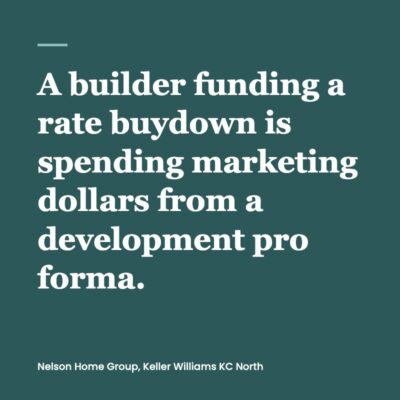
A builder funding a rate buydown is spending marketing dollars from a development pro forma. A seller matching that is spending net proceeds. Those are not the same money and they do not last the same number of rounds. The builder also does it on every house in the subdivision, all year, as a standing program. You do it once, on your house, in one negotiation.
None of that makes a growth suburb a bad purchase. It changes what you should expect your exit to look like, and it argues for a longer hold than you might otherwise plan.
What Is a Special Assessment and Why Does It Show Up in New Subdivisions?
Somebody has to pay for the streets, the sewer laterals, the stormwater work and sometimes the trail system in a brand new subdivision. That cost is frequently financed and repaid through a special assessment or an improvement district charge that rides on the property tax bill. The term is not standard. Kansas caps its improvement-district assessments at 20 annual installments and the city picks the actual number in the assessment ordinance. A Missouri community improvement district has no statutory term cap at all, and the expiration date is whatever went into the petition.
Fannie Mae’s Selling Guide lists special assessments by name in the monthly housing expense lenders qualify you on.
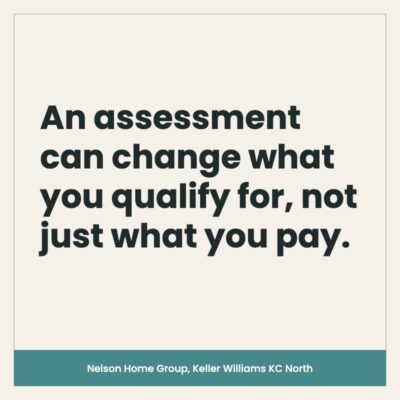
Here is where the two states split, and almost nobody writes this down. In Kansas, the seller has to disclose a special assessment as part of the contract or before you sign it, and has to get your written acknowledgment back. Missouri has no equivalent seller-disclosure statute for these. In Missouri a neighborhood improvement district gets recorded with the county recorder of deeds, and a community improvement district assessment is a lien the county collector can add to the tax bill, so it surfaces in the title work and the tax records rather than in a statutory disclosure. As a licensed mortgage loan originator I care for a second reason: Fannie Mae counts special assessments in your monthly housing expense, which means it counts in your debt to income ratio. An assessment can change what you qualify for, not just what you pay. Run the full monthly number, assessment included, through my mortgage calculator before you decide what you can carry.
Either way, ask your title company for the assessment history on the specific parcel before you write an offer. Not the subdivision. The parcel. Get the current annual amount and how many years are left. For the rest of what changes at the state line, see my Kansas vs Missouri cost breakdown.
When Do Services Catch Up to the Rooftops?
It depends on how the project was financed. Infrastructure can be built before, alongside, or after the housing, depending on bonds, impact fees, district financing and the city’s adopted capital plan. Where it lags, that lag is measured in years and it is visible in public documents.
For a buyer, the useful move is to read the city’s own capital plans and council packets for the area you are considering. Those documents will tell you what is funded, what is in design, and what is still a line item somebody hopes to fund later. That is a much better predictor of the next five years than any growth percentage.
How Should You Actually Use Growth Data as a Buyer?
Use it as a character forecast, not a return forecast. A city adding 35% to its population is going to feel different in five years: new traffic patterns, new retail, new school boundaries, a different commute. That is genuinely useful information when you are choosing where to live.
What growth will not tell you is your return. For that you want current inventory, the pace of sales in your price band, how many new homes are scheduled to deliver near you, and what financing costs are doing. My latest Kansas City market update carries the live Heartland MLS numbers, and that is where I would send you for the price side of this question.
Growth is a reason to look at a place. It is not a reason to skip the diligence.
Friday’s companion post covers Kansas City new home permits by city, which is the supply-side number to read before you decide what nearby new construction means for your resale.
Frequently Asked Questions
Do home prices always go up in fast-growing areas?
No. Fast growth means new housing supply is being built, and that supply competes with existing homes. Prices respond to the balance of supply and demand in a specific price band in a specific month, along with mortgage rates and local inventory. A high population growth rate tells you people are arriving. It does not tell you whether there are more buyers than houses this quarter.
How much do home prices actually rise when population grows?
Less than most people assume. Freddie Mac’s 2021 research found that a 1% increase in population raises house prices by about 0.03%, while a 1% increase in per capita income raises them by about 1.5%. Their analysis concluded population accounts for only 0.5% of the change in house prices. Those are national figures, so treat them as direction rather than a local forecast.
How does new construction affect the value of my existing home?
New construction gives buyers an alternative with incentives attached, and a builder runs those incentives as a standing program across a whole subdivision. A seller can fund a buydown too, within interested-party contribution limits, but pays for it out of net proceeds on one transaction. The practical difference is capacity and repetition, not whether the tool is available to you.
How long does a special assessment last on a new construction home?
There is no standard term, so look it up for the parcel. Kansas caps improvement-district assessments at 20 annual installments and the city sets the actual number in the assessment ordinance. A Missouri community improvement district has no statutory term cap; the expiration date comes from the petition. A Missouri neighborhood improvement district runs for the duration stated in the ballot measure or petition that created it.
Should I avoid buying in a fast-growing suburb?
Not at all. It means you plan differently. Expect new construction to compete with your resale, expect a possible assessment on the tax bill, and expect infrastructure to arrive after the houses. If those are priced into your decision and your hold period is long enough to get past the heaviest building years, a growth suburb can be a good purchase.
Where can I find current Kansas City home price data?
My monthly Kansas City market update runs on Heartland MLS Local Market Update data and carries median sale price, days on market, months of supply and county level splits with the report date attached. That post is refreshed every month. I keep hard price figures there rather than scattered across other posts so the site never shows two different medians for the same month.
Ready to Talk?
If you are looking at a new build and want a straight read on the assessment, the incentive package, and what your resale competition looks like in five years, send it to me. I can look at the loan side and the resale side in the same conversation, which is the whole reason I carry both licenses. Call or text me, or send me an email.
Call or text: (816) 680-6624
KW KC North Office: (816) 452-4200
Email: [email protected]
Web: https://nelsonhomegroupkc.com/
Nelson Home Group, Keller Williams KC North, 1508 NW Vivion Rd, #205, Kansas City, MO 64118