

Does the ROAD to Housing Act Ban Investors From Buying Houses?
By Joe Nelson — Retired Air Force, Nelson Home Group Team Leader and Mortgage Loan Originator
No. The new housing law everyone is posting about, officially the 21st Century ROAD to Housing Act (Public Law 119-101), restricts large institutional investors, defined as for-profit entities with investment control of 350 or more single-family homes, from buying more of them starting January 7, 2027. It does not force anyone to sell what they already own, it does not reach independent local landlords, and its exemption list is long. The headlines calling it a ban are wrong in one direction, and the people saying it changes nothing are wrong in the other.
I broke the whole law down on video, including the parts that do not make headlines. Watch the complete breakdown here.
I am Joe Nelson, a Kansas City Realtor and licensed mortgage originator, and I watched the investor wave this law targets move through our market firsthand. Here is what the law actually says.
Who Does the ROAD to Housing Act Cover?

Up to $1 million is a ceiling. Not an automatic fine.
The restriction applies to for-profit entities, funds, and companies that hold investment control of 350 or more single-family homes, alone or in concert with other entities. That phrase “in concert” is doing real work. A large operator cannot slip under the threshold by splitting a portfolio across a stack of LLCs. What the threshold does not do is reach down the ladder. Your local landlord with six rentals is not covered. An independent partnership with a dozen doors is not covered. This is aimed at the biggest operators, the ones holding portfolios in the tens of thousands nationally.
The statute also defines a single-family home more narrowly than most coverage admits: a structure with two or fewer dwelling units intended for a single household. Manufactured homes are excluded outright.
If a covered investor buys anyway, the government can seek a civil penalty of up to $1 million per violation or three times the purchase price, whichever is greater. Read those two words again: up to. That is a ceiling an enforcement action has to argue for, not a fine that lands automatically. And enforcement runs through the government. The law does not give private parties the right to sue over it.
Covered companies do have to tell HUD each year how many homes they control and the city and state where those homes sit, though they are not required to itemize any city where they own 10 or fewer. HUD then publishes an aggregated annual report. That is a real transparency gain, and it is worth being precise about what it is not: nobody is getting a public, house-by-house database of who owns what on your street.
| Provision | What the law says |
|---|---|
| Covered investor | A for-profit entity with investment control of 350 or more single-family homes, alone or in concert with others |
| Covered property | A structure with two or fewer dwelling units. Manufactured homes are excluded |
| Restriction begins | January 7, 2027, which is 180 days after enactment |
| Restriction ends | January 7, 2042, unless Congress changes it |
| Existing holdings | No forced sale of homes purchased before July 11, 2026 |
| Major exceptions | Qualifying build-to-rent, renovate-to-rent at 15 percent or more of purchase price, renovate-for-sale, homeownership programs, lender and servicer loss mitigation, age-55-plus communities, and certain investor-to-investor transfers |
| Purchases from smaller investors | Allowed through January 7, 2029 |
| Enforcement | Federal civil enforcement. No private right of action |
| Maximum civil penalty | Up to $1 million per violation or three times the purchase price, whichever is greater |
What Investor Purchases Are Still Legal?
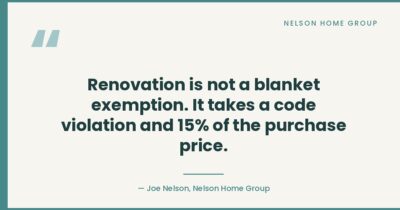
Renovation is not a blanket exemption.
This is the part the headlines skip. Homes these companies already own stay theirs. There is no forced sell-off. Past that, the exemptions are specific rather than blanket, and the difference matters if you are trying to predict who you will be bidding against in 2027.
Qualifying build-to-rent purchases are exempt. Renovate-to-rent is exempt, but only where the home fails local building code and the investor puts in improvements worth at least 15 percent of the purchase price. Homes bought to be renovated and put back on the market for sale are carved out as well, as long as they are not rented while they sit. That keeps a real share of the flip-and-resell model running, but it does not hand every flip or every iBuyer purchase an automatic pass.
Foreclosures are narrower than almost everyone assumes. The exemption covers lenders and servicers taking a property through loss mitigation, deed in lieu, or enforcement of a mortgage they already held. It is not a green light for an investor to buy any foreclosure that hits the courthouse steps. Large investors can also buy from each other under specific conditions, and they can keep buying from non-covered investors through January 7, 2029.
Add it up and the honest description is a speed limit on the next buying frenzy, not a reversal of the last one. And it is a temporary one. The whole restriction sunsets January 7, 2042.
How Is This Law Different From Other Proposed Bills?
Those other proposals are not law. That is the short answer, and it is the one most of the internet is getting wrong. Congress has seen bills that went much further, including proposals that would have forced hedge funds to divest their entire single-family portfolios over a period of years. Several states are debating their own restrictions too. None of that is what became law on July 11, 2026. The ROAD to Housing Act version is a purchase restriction on the biggest operators, with a long exemption list, starting in January 2027. If a social media post tells you Wall Street has to sell your neighborhood back, it is describing a bill that did not pass.
Are Kansas City Buyers Still Competing With Investors?
Yes, but not with the ones this law was written to stop, and that distinction is the whole story here.
In 2021 and 2022, institutional buyers were taking down the exact starter homes my first-time buyers were bidding on, and some were flat-out overpaying. In my files, that head-to-head competition from the largest operators is far less common today. My read on why: Kansas City resale buyers saw straight through a light cosmetic flip, the numbers stopped working, and those groups pulled back. That is my transaction-level experience, not a metro-wide statistic.
The national data points the same direction. Realtor.com found that mega investors, which it defines as buyers with 350 or more purchases, the same threshold this law uses, fell to 7.5 percent of all investor purchases in 2025. That is their smallest share since 2011 and down nearly 70 percent from the 2021 peak.
Here is the part nobody is telling you, though. Kansas City had the second highest investor share of any metro in the country in 2025, at 21.2 percent of all purchases, up 1.5 points from the year before. Only Memphis was higher. Investor activity here did not disappear. It changed hands. Small investors, the ones this law was never written to touch, picked up what the giants put down.
So what does that mean if you are trying to buy a house? The Wall Street story that has kept you on the sidelines is three years old, and it might be costing you a house. But do not walk in thinking the competition left. You are competing with local investors who move fast and pay cash, and a federal restriction that arrives in 2027 does nothing about what happens at a Saturday showing this month. Know where the Kansas City market actually sits before you write an offer. The full local breakdown of the law is here: Road to Housing Act: What It Changes for Kansas City Buyers. First-time buyer in this fight for entry-level houses? I wrote what this law actually does for first-time home buyers. And if you are a veteran, the law changes your mortgage paperwork too, and I broke down what it means for VA loans.
Frequently Asked Questions
Does the 350-home limit apply to small landlords and local investors?
No. The restriction only reaches for-profit entities with investment control of 350 or more single-family homes, counted alone or in concert with other entities. A local landlord with a handful of rentals or an independent partnership with a dozen doors is nowhere near that threshold.
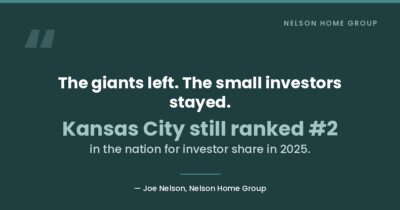
The giants left. The small investors stayed.
When do the ROAD to Housing Act investor restrictions actually start?
January 7, 2027. That is 180 days after the law was enacted on July 11, 2026. Nothing about investor purchasing changes before that date, and the restriction sunsets on January 7, 2042.
Does the law force corporate landlords to sell homes they already own?
No. The Act expressly does not require covered investors to sell homes purchased before it took effect. It restricts future non-excepted purchases only.
Can large investors still buy houses to renovate and resell?
Sometimes. Renovate-to-rent qualifies only where the home fails local building code and the investor makes improvements worth at least 15 percent of the purchase price. Renovate-for-sale qualifies as long as the home is not rented while it waits for a buyer. Renovation by itself is not a blanket exemption.
Does the law create a public database of investor-owned homes?
No. Covered investors report their holdings and the city and state to HUD, and they can skip itemizing any city where they own 10 or fewer homes. HUD publishes an aggregated annual report. There is no public, address-level lookup coming out of this law.
Will this remove investor competition in Kansas City?
No. Kansas City had the second highest investor share in the country in 2025 at 21.2 percent, and that share is being driven by small investors this law does not cover. The restriction also does not begin until January 7, 2027. Plan on competing with local investors regardless.
Have more Kansas City buyer and seller questions? I answer twenty-five of the most common ones here.
Ready to Talk?
Here is the thing. I write these posts and make these videos because I want to work with you. That is the whole reason I do this. You do not need to have everything figured out before you reach out. That is what the conversation is for.
Call: (816) 680-6624
Email: [email protected]