

How Much Cash Do You Need to Assume a VA Loan?
By Joe Nelson, Retired Air Force, Nelson Home Group Team Leader and Mortgage Loan Originator
How much cash you need to assume a VA loan comes down to the equity gap plus fees: the sale price minus the unpaid principal balance you take over at closing, plus a VA funding fee of 0.5 percent of that balance, plus closing costs. The listing price alone cannot tell you the number. The loan balance can, and it is the first thing to ask about on any assumable listing. I am a Kansas City Realtor and licensed mortgage loan originator, and I watched this exact question get answered wrong all over a comment section, so let us do the real math.
Free VA Home Buying Guide for Kansas City: the full VA playbook from eligibility to closing. Sign up at the VA Home Buying Guide for Kansas City and I will send it to you, free.
What is the equity gap on a VA loan assumption?

Ask the servicer for the projected balance at closing, not the balance on last month statement.
The equity gap is the difference between what you are paying for the house and the loan balance you are taking over. You assume the loan, but the seller’s equity has to be covered at closing, and in practice that money is almost always cash. The section below on second loans explains why.
The gap is also your search filter. A seller who bought recently with nothing down usually leaves a smaller gap. A seller with years of appreciation and principal paid down leaves a much bigger one. But do not guess from the purchase year, because the down payment, extra principal payments, and the contract price all move the number. The more equity the seller has, the more cash or approved secondary financing you need to bring. Stop hunting low rates and start hunting low balances.
What loan balance should you ask the servicer for?
Ask for the current unpaid principal balance and the projected balance at closing. Those two numbers, not a payoff quote and not a listing remark, are what your equity gap is built from. A payoff figure is the amount required to retire the loan and can carry accrued interest and other charges, so it is the wrong number for this math.
It matters because federal law is written the same way. The VA assumption funding fee is set at one half of one percent of the unpaid principal balance of the loan on the date of the transfer. At Nelson Home Group, I start every Kansas City VA assumption with the servicer’s projected loan balance, not the listing price.
How do you calculate cash to close on an assumption?
Start with the sale price minus the unpaid principal balance you are assuming. Add the 0.5 percent funding fee and closing costs. That is your planning number. Now apply it to the real question I watched a veteran ask online: how much cash does it take to assume the loan on a $279,000 house? The price does not decide it. The balance does. Here are two versions of the same house.
| Line item | Balance assumed $240,000 | Balance assumed $150,000 |
|---|---|---|
| Sale price | $279,000 | $279,000 |
| Unpaid principal balance you assume | $240,000 | $150,000 |
| Equity gap due at closing | $39,000 | $129,000 |
| VA funding fee (0.5% of balance) | $1,200 | $750 |
| Servicer processing fee | Up to $300 | Up to $300 |
| Assumption locality variance (Kansas and Missouri) | Up to $386 | Up to $386 |
| Other closing costs | Varies by servicer | Varies by servicer |
| Cash to plan for | $40,886 plus other closing costs | $130,436 plus other closing costs |
Funding fee per VA Circular 26-23-10, collected at closing and not financed into the loan. Locality variance per VA Circular 26-24-5, Exhibit A, which places Kansas and Missouri in the $386 Midwest region.
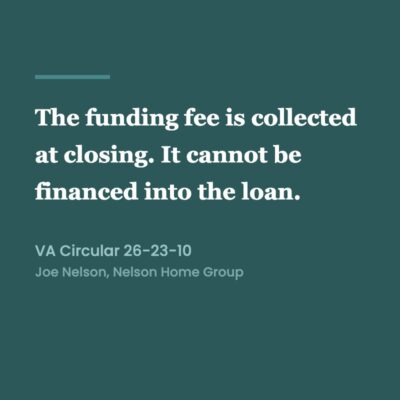
Budget the fee as cash on top of the gap, the same way you would budget a down payment.
Same house. Same price. Completely different deal. The Nelson Home Group cash test starts with the balance, not the listing price. To model the payment on the balance you would be assuming at the rate you would be inheriting, my mortgage calculator will run principal, interest, taxes, and insurance. Add the 0.5 percent assumption fee separately, because the calculator has purchase and refinance settings and no assumption setting.
Can you finance the equity gap with a second loan?
Sometimes, and availability is the hard part. VA does not prohibit it. VA Circular 26-24-17 says VA does not prohibit an assumer from taking on secondary borrowing, that the second loan has to sit in a junior lien position behind the VA loan, that the money can go toward allowable closing costs or amounts due the seller at closing, and that the assumer cannot walk away with cash back. The payment on that second loan also counts against you when the servicer looks at your debts.
Permission is not the same as availability. In the files I see, lenders willing to take second position behind a loan they do not service are scarce, and I cannot write that second loan myself. National products exist, but their combined loan limits and down payment requirements move, so get a current written product sheet before you build an offer around one.
Plan on the gap being cash. If a lender does offer you a second loan, run both loans together before you celebrate, because the second loan’s rate, fees, term, and payment can eat the exact savings you came for. This is precisely where having a loan originator in your corner earns its keep.
What fees does the servicer charge on a VA loan assumption?

Ask the servicer to confirm your own exemption status in writing before closing day.
Budget for three things beyond the gap. First, the VA funding fee at 0.5 percent of the balance being assumed. It is collected at closing and cannot be financed into the loan, and it is charged to the assumer, meaning the buyer taking the loan over. VA Circular 26-23-10 puts it plainly: a funding fee of 0.5 percent of the loan balance must be paid on an assumption unless the assumer is eligible for a fee waiver. The seller’s exemption does not carry over to you.
Second, the servicer’s own charges. VA caps the base assumption processing fee at $300 on automatic authority files or $250 on prior approval files, but that is not the whole story. VA Circular 26-24-5 authorizes an assumption locality variance on top of the base fee, and Exhibit A puts Kansas and Missouri in the Midwest region at $386. So the servicer’s paperwork alone can run close to $700 before title, recording, and prorations. Demand the full fee list in writing early, and check the current VA funding fee rules while you are at it.
Third, ask whether your file needs reserves. VA sets no blanket cash reserve requirement, but specific situations bring one in, such as a multi-unit property or qualifying with rental income, so get the servicer’s answer up front.
The good news is what you usually skip. A new VA appraisal is not part of VA’s assumption process, which is a credit and eligibility review rather than a new origination, and you avoid most of the origination charges a brand new loan carries. Confirm in writing whether the servicer wants a valuation of its own, and order a home inspection either way.
The rest of my five-part VA loan assumption series:
- What Is a VA Loan Assumption and How Does It Work in Kansas City?
- Can a Non-Veteran Assume a VA Loan?
- Can You Use Your VA Loan Again After Someone Assumes It?
- How Long Does a VA Loan Assumption Take?
Frequently Asked Questions
Is there a down payment on a VA loan assumption?
Not in the traditional sense. Your money goes to the equity gap, the difference between the price and the balance you are assuming. If the gap is $39,000, that is effectively your down payment, and it is due at closing.
What is the VA funding fee on an assumption?
The assumption funding fee is 0.5 percent of the unpaid principal balance being assumed on the transfer date. On a $240,000 balance that is $1,200. It is charged to the person assuming the loan, and that person pays it unless they qualify for a funding fee waiver of their own.
Can the VA assumption funding fee be added to the loan?
No. VA policy requires the 0.5 percent assumption funding fee to be collected at closing, and it cannot be financed into the loan balance. If you qualify for a waiver, document it with the servicer before closing day.
Can I use gift funds or a 401(k) loan for the equity gap?
Gift funds can work when the donor is not a party to the deal, the gift letter says repayment is not expected, and the transfer is documented. A 401(k) loan is different: disclose it, and know that an asset pledged against a loan cannot also be counted as your available funds. Bring the servicer’s answer to me and we will check it against the rest of the file before you write the contract.
Does earnest money reduce the cash I bring to closing?
Yes, when the deposit is being held and credited back to you at settlement. It does not shrink the equity gap or the purchase price. It just means part of the money is already sitting in escrow instead of leaving your account on closing day.
Are closing costs lower on an assumption than on a new loan?
Usually. You skip most new loan origination charges and a new VA appraisal is not part of the process. But the servicer can charge a base assumption processing fee of up to $300, or $250 on prior approval files, plus a $386 assumption locality variance here in Kansas and Missouri. Get the full fee list in writing before you commit.
Ready to Talk?
Before you write an offer on an assumable listing, let us get the projected loan balance from the servicer and run your full cash to close together. Ten minutes of math now beats a dead contract in October.
Call: (816) 680-6624
KW KC North Office: (816) 452-4200
Email: [email protected]
Web: https://nelsonhomegroupkc.com/