

March 20, 2026 — Kansas City Real Estate Market: February 2026 Proves KC Is Built Different
By Joe Nelson — Nelson Home Group Team Leader and Mortgage Loan Originator
Get the free February 2026 KC Market Report — the actual Heartland MLS numbers in plain English. No Zillow estimates.
CLICK HERE→ https://nelsonhomegroupkc.com/wp-content/uploads/2026/03/February-2026-Kansas-City-Housing-Market-Update.pdf
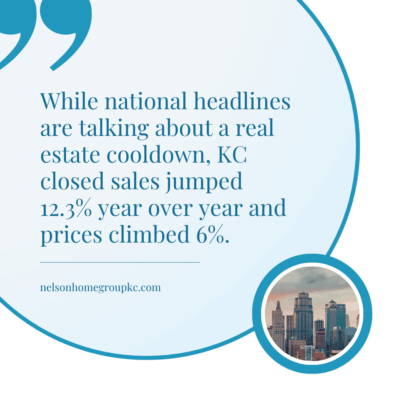
The Kansas City real estate market just delivered one of its strongest February performances on record — at a time when most markets across the country are slowing down. While national headlines are talking about a real estate cooldown, KC closed sales jumped 12.3% year over year and prices climbed 6%.
I pull the Heartland MLS data every single month — not Zillow estimates, not national headlines — so buyers and sellers in KC have the real picture. Here’s what February 2026 showed.

What the Kansas City Real Estate Market Is Showing in February 2026

| Metric | Feb 2025 | Feb 2026 | Change |
|---|---|---|---|
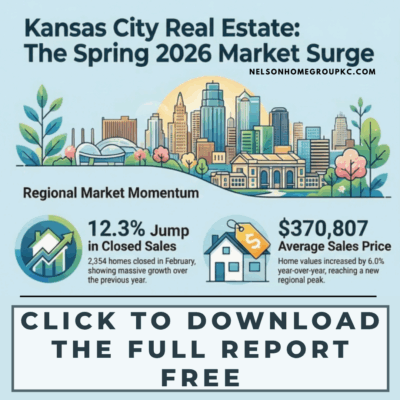
| Closed Sales | 2,097 | 2,354 | +12.3% |
| Avg Sales Price | $349,923 | $370,807 | +6.0% |
| Median Sales Price | $303,400 | $315,000 | +3.8% |
| Days on Market | 56 | 57 | +1.8% |
| Pending Sales | 2,623 | 2,823 | +7.6% |
| % of Original List Price | 96.7% | 96.3% | -0.4% |
| Active Inventory | 6,746 | 6,808 | +0.9% |
| Months of Supply | 2.2 mo | 2.2 mo | 0.0% |
Source: Heartland MLS, February 2026
While most markets across the country are reporting a slowdown or outright contraction, the Kansas City real estate market went the other direction — posting a 12.3% jump in closed sales and a 6% increase in average price year over year. That kind of divergence from the national narrative isn’t luck. It’s a market with real underlying demand.
The number worth paying the most attention to isn’t prices or closed sales — it’s pending sales. At 2,823 pending contracts in February alone, up 7.6% year over year, that’s a forward-looking signal that spring 2026 is already loading. Pending sales tell you where the market is going, not where it’s been. And sellers are still receiving 96.3% of their original asking price — this is not a market where you need to slash your list to move a home.
Kansas City Housing Market Update 2026: YTD Numbers
Year-to-date, the picture is even clearer:
- YTD Closed Sales: 4,428 (+8.1%)
- YTD Avg Price: $373,064 (+6.8%)
- YTD Median Price: $315,000 (+5.0%)
- YTD Pending Sales: 5,511 (+12.7%)
That’s not a blip. That’s a trend.
The Cost of Waiting — A Real Kansas City Story
The best example I can give you of what waiting costs isn’t a spreadsheet. It’s a client named Kylie.
In 2017, Kylie bought a small bungalow in North Kansas City for $87,000. At the time, it was a stretch. She was a single mom. She had a toddler and a dog. But she bought it.
Fast forward to today — Kylie has approximately $130,000 in equity sitting in that house. And one block away, her dream home hit the market: twice the size, fully remodeled, basement, priced in the low $300s. This was her house.
The problem: she was a contingent buyer. She needed to sell before she could buy. She put in the offer. Another buyer beat her out. She didn’t get it.
But here’s what happened next: we made such an impression on that seller that when their first buyer cancelled, they called us. Kylie listed her home the very next day. Four days later, she was under contract at full list price.
She is now buying that dream home — one block from where she started.
That is what getting in looks like. Not timing the market perfectly. Not waiting for rates to hit some magic number. Just getting in.
If you’re in a situation like Kylie’s — you need to sell before you buy — don’t assume you’re stuck. There’s a strategy. Reach out and let’s map it out.
If you’re a contingent buyer wondering how to navigate a sale and purchase simultaneously, here’s what you need to know.
Be Kylie. Don’t wait for perfect. Get in.
Here’s something most agents aren’t connecting for their clients right now: what’s happening in Iran is directly affecting your mortgage rate in Kansas City.
Here’s the chain: oil prices have spiked over 7% since the conflict escalated. When oil prices spike, inflation fears rise. When inflation fears rise, investors move money out of bonds, which drives the 10-year Treasury yield up — it moved from 3.96% to over 4.16% in a matter of days. And mortgage rates follow the 10-year Treasury.
So where does that leave us? Rates are sitting around 6% right now — approximately one full percentage point lower than this time last year. That’s real savings on a monthly payment. But the recent upward pressure on the Treasury yield means the window isn’t guaranteed to stay open.
The honest picture on rates: they’re not going to 4%, and they’re not going to 8% either. We’re likely in a 5.9–6.3% range for the foreseeable future. The question isn’t whether rates are perfect. The question is whether you can afford to wait while prices keep climbing 4–6% annually.
I’m not just a real estate agent — I’m also a licensed mortgage originator. That means I can actually run your numbers, tell you what today’s rate means for your specific monthly payment, and show you what waiting a year actually costs you in real dollars. Reach out and let’s run the math together.
If you’re a veteran or military family, VA loan options may significantly change what’s possible for you in today’s market.
Should You Buy or Sell in Kansas City Right Now?
If you’re a seller: prices are up 6% year over year. Closed sales volume is up 12.3%. Pending sales are surging and the spring pipeline is already building. You are not sitting in a national market right now — you’re sitting in one of the strongest local markets in the country. Sellers are still receiving 96.3% of asking price with only 2.2 months of supply. This is a favorable market to list.
If you’re a buyer: I know rates feel like a roadblock. But here’s the math that matters: every month you wait in a market appreciating at 6% annually is a month you’re paying more for the same house. Rates are about 1% lower than they were last year. And that 2,823-pending-sales figure means your competition this spring is already in contract. The buyers who are winning aren’t waiting for perfect — they’re acting on real data.
Thinking about relocating to Kansas City? The Northland — Liberty, Kearney, Smithville, North KC — continues to be one of the most in-demand and value-strong pockets in the metro.
Want to know what your KC home is worth in today’s market? I’ll give you a real, market-based picture — not a Zillow estimate.
The Takeaway
The Kansas City housing market update 2026 tells one story: KC is built different. While markets across the country are cooling, Kansas City is one of the few metros where prices and sales volume are both trending up — and the pending sales data says spring is going to be even stronger.
I’m Joe Nelson — 21-year Air Force veteran, licensed real estate agent and licensed mortgage originator in Kansas City. Every month I pull the real Heartland MLS numbers so you know exactly what’s happening in your market. If you’re ready to stop watching and start moving, reach out.
Book a Free Call | Get My Home Value | Download KC Relocation Guide

Q1: Is now a good time to buy a home in Kansas City?
A: Yes — February 2026 Heartland MLS data shows closed sales up 12.3% YOY, mortgage rates approximately 1% lower than last year, and pending sales up 7.6% — signaling a strong spring ahead. Waiting typically means buying at a higher price in a more competitive market.
Q2: What is the average home price in Kansas City in 2026?
A: The average sales price in the Kansas City metro reached $370,807 in February 2026, up 6.0% from $349,923 in February 2025, according to Heartland MLS.
Q3: What is the median home price in Kansas City?
A: The median sales price in Kansas City was $315,000 in February 2026, up 3.8% year over year from $303,400.
Q4: How long are homes sitting on the market in Kansas City?
A: Homes in the Kansas City metro are selling in an average of 57 days as of February 2026 — up slightly from 56 days in February 2025.
Q5: Are Kansas City home prices going up in 2026?
A: Yes. Average prices rose 6.0% YOY and median prices rose 3.8% YOY as of February 2026 Heartland MLS data — outperforming most U.S. metros where prices are flat or declining.
Q6: What percentage of asking price are Kansas City sellers getting?
A: Kansas City sellers received 96.3% of their original asking price in February 2026, according to Heartland MLS. With 2.2 months of supply, the market continues to favor sellers.
Q7: What are mortgage rates in Kansas City right now?
A: As of early March 2026, mortgage rates are approximately 6% — roughly 1% lower than the same period last year. Rates are influenced by the 10-year Treasury yield, which has recently climbed due to oil price increases tied to Iran conflict escalation.
Q8: Can I buy a home in Kansas City if I need to sell my current home first?
A: Yes — contingent purchases are possible and common in KC. Strategy matters: proper pricing, timing, and seller relationship management are key. A real example from our team resulted in a 4-day full-price sale for a contingent seller-buyer.
Q9: What is the best neighborhood in Kansas City for military families?
A: The Kansas City Northland — including Liberty, Kearney, Smithville, and North KC — is a top area for military families relocating to Fort Leavenworth. For relocation resources, see our KC Relocation Guide.
Q10: Who is the best VA loan lender in Kansas City?
A: Joe Nelson with Nelson Home Group is both a licensed real estate agent and a licensed mortgage originator specializing in VA loans in the Kansas City metro. He works with veterans relocating to Fort Leavenworth and retiring in the KC area.
| 📞 Call: 816-680-6624
📧 Email: joe@nelsonhomegroupkc.com 📅 Book a free call: https://calendly.com/joenelson |
All real estate services are provided in accordance with Fair Housing laws. We welcome buyers of all backgrounds and do not discriminate on the basis of race, color, national origin, religion, sex, familial status, disability, or any other protected class.